










Researchers at Xi'an Jiaotong University make new advances in the treatment of inflammatory bowel disease
Ulcerative colitis (UC) has become a common disease of the digestive system, with the incidence of UC increasing year by year in China and even worldwide, and the population tending to be younger and younger.UC is characterised by prolonged and recurrent attacks, and the pathogenesis of UC is not yet completely clear, making it impossible to cure, and it is classified by the WHO as one of the difficult-to-treat diseases, and the clinical treatment lacks effective drugs. The pathogenesis of UC is not fully understood and it cannot be completely cured. Traditional Chinese medicine (TCM) has the advantages of precise efficacy, low recurrence rate and few toxic side effects in the treatment of UC, but due to the lack of precise material basis of efficacy and related molecular mechanisms, the progress of new drug discovery and development of TCM has been slow.
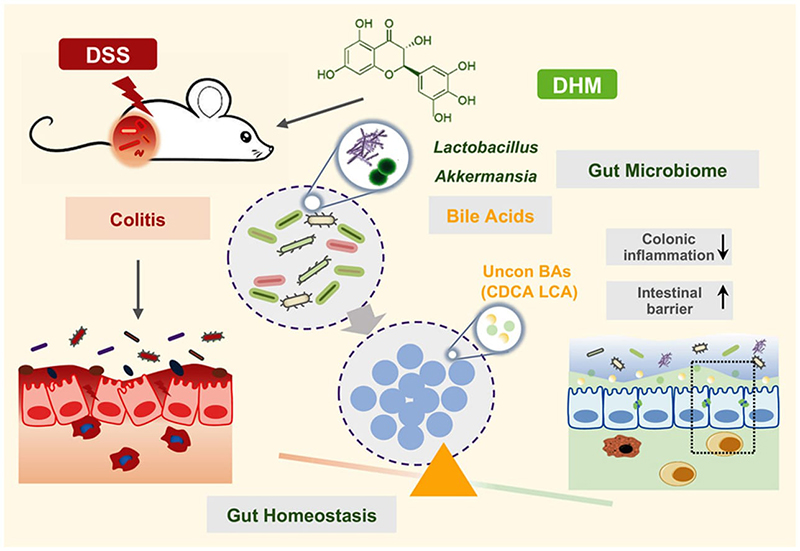
Researchers from the School of Pharmacy at Xi'an Jiaotong University recently found that Dihydromyricetin (DHM), the main active ingredient in Vitis vinifera tea, can significantly improve the symptoms of colitis, intestinal barrier disruption and colon inflammation in mice. Structural analysis of the intestinal flora of mice showed that DHM was effective in improving intestinal dysbiosis in UC mice, and results from pseudo-sterile mice and antibiotic faecal transplantation experiments showed that the efficacy of DHM was closely related to the intestinal flora. Further metabolomics studies showed that DHM could regulate the synthesis of unconjugated BA (UBA), which could activate the intestinal epithelial FXR/TGR5 signalling pathway and ultimately inhibit inflammation and restore intestinal barrier integrity.
Recent studies show that the dietary supplement dihydromyricetin (DHM) can alleviate IBD in mouse models by down-regulating inflammatory pathways. However, the molecular mechanistic link between the therapeutic efficacy of DHM, gut microbiota and the metabolism of microbial BAs remains elusive. In this study, we investigated the improvement of DHM on the dysregulated gut microbiota of mice with dextran sulphate sodium (DSS)-induced colitis. We found that DHM could significantly improve colitis symptoms, intestinal barrier dysfunction and colonic inflammation in DSS-treated mice. In addition, bacterial 16S rDNA sequencing assay showed that DHM could alleviate gut dysbiosis in colitis-infected mice. Furthermore, antibiotic-mediated gut microbiota depletion and faecal microbiome transplantation (FMT) showed that the therapeutic efficacy of DHM was closely related to the gut microbiota. BA-targeted metabolomics analysis revealed that DHM restored the metabolism of microbial BAs in the gastrointestinal tract during the development of colitis. DHM significantly eNRiched the proportions of the beneficial genera Lactobacillus and Akkermansia, which correlated with increased gastrointestinal levels of unconjugated BAs, including chenodeoxycholic acid and lithocholic acid, enabling the BAs to activate specific receptors, such as FXR and TGR5, and maintain intestinal integrity. Taken together, DHM could alleviate DSS-induced colitis in mice by restoring the dysregulated gut microbiota and BA metabolism, leading to improvements in intestinal barrier function and colonic inflammation. Increased microbiota-BAs-FXR/TGR5 signalling may be the potential targets of DHM in colitis. Therefore, our findings provide new insights into the development of novel DHM-derived drugs for the treatment of IBD.
The results of this study have been published in the prestigious journal Pharmacological Research under the title Dihydromyricetin improves DSS-induced colitis in mice via modulation of fecal-bacteria-related bile acid metabolism. Pharmacological Research . Associate Professor Wang Hui Jing from the School of Pharmacy at Xi'an Jiaotong University and researcher Haitao Lv from Shanghai Jiaotong University were the first and co-corresponding authors of the paper. Sijing Dong, a PhD student of XJTU, was the first author, and Longlong Hu, a PhD student of SJTU, Prof. Sicen Wang and Associate Prof. Ke Wang of XJTU participated in the research. The research was supported by the National Natural Science Foundation of China, the National Key Research and Development Programme and the Natural Science Foundation of Shaanxi Province.